Qwen2.5-Coder-14B: Fine-Tuned Model for n8n Workflows
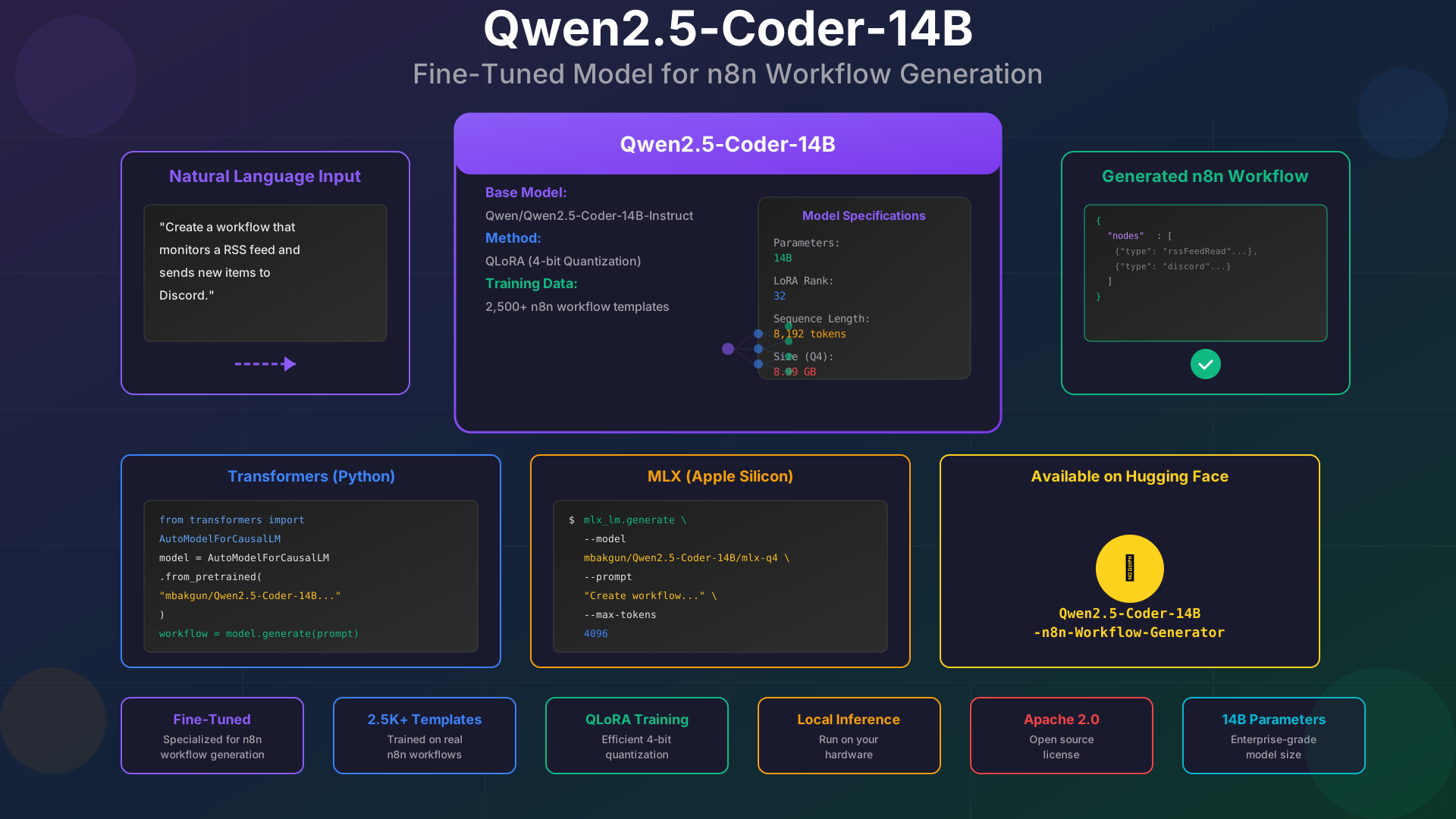
We are excited to announce the release of Qwen2.5-Coder-14B-n8n-Workflow-Generator, a specialized fine-tuned language model designed specifically for generating n8n workflow configurations from natural language descriptions. This model represents a significant milestone in AI-powered workflow automation, bringing enterprise-grade code generation capabilities directly to the n8n community.
What is Qwen2.5-Coder-14B-n8n-Workflow-Generator?
This model is a fine-tuned version of Qwen/Qwen2.5-Coder-14B-Instruct, one of the most capable code generation models available today. Through a process called QLoRA (Quantized Low-Rank Adaptation), we trained the model on over 2,500 n8n workflow templates from the n8n public template gallery. The result is a model that understands n8n's workflow structure, node configurations, and best practices.
Unlike general-purpose code models that require extensive prompting to generate n8n workflows, this specialized model produces accurate, functional n8n workflow JSONs with minimal guidance. Simply describe what you want to automate, and the model generates a complete workflow configuration ready to import into n8n.

Why This Matters for n8n Users
Creating n8n workflows manually can be time-consuming, especially for complex automations involving multiple integrations, data transformations, and conditional logic. This fine-tuned model changes that by:
- Reducing Development Time: Generate complete workflows in seconds instead of hours
- Improving Accuracy: Trained specifically on n8n workflows, reducing syntax errors and configuration mistakes
- Enabling Natural Language Automation: Describe your automation needs in plain English and get working code
- Supporting Local Deployment: Run inference locally on your hardware for privacy and cost control
- Learning from Best Practices: Model learned from thousands of real-world n8n templates
Technical Deep Dive
Understanding the technical foundation helps explain why this model performs so well for n8n workflow generation.
Base Model Architecture
The model is built on Qwen2.5-Coder-14B-Instruct, a 14-billion parameter transformer model specifically designed for code generation tasks. Qwen models are known for their strong performance in multilingual code understanding and generation, making them ideal for workflow automation scenarios.
Fine-Tuning Method: QLoRA
We used QLoRA (Quantized Low-Rank Adaptation) to fine-tune the model efficiently. This technique allows us to train large models with significantly less memory while maintaining performance:
- 4-bit Quantization: Reduces model memory footprint by 75%
- LoRA Rank 32: Adds trainable parameters for n8n-specific knowledge
- LoRA Alpha 64: Controls the influence of fine-tuned weights
- Training Steps: 432 steps across 3 epochs for optimal learning
- Sequence Length: 8192 tokens to handle complex workflows
Training Dataset
The model was trained on the n8nbuilder-n8n-workflows-dataset, which contains over 2,300 high-quality n8n workflow templates. Each template was converted into an instruction-following format where:
- Instruction: Natural language description of the workflow
- Input: Additional context or requirements
- Output: Complete n8n workflow JSON configuration
This dataset covers diverse automation scenarios including email processing, data synchronization, API integrations, social media automation, and more.
How to Use the Model
The model is available on Hugging Face and can be used in multiple ways depending on your infrastructure and requirements.
Using Transformers (Python)
For most users, the Transformers library provides the easiest way to use the model:
from transformers import AutoModelForCausalLM, AutoTokenizer
import torch

model_name = "mbakgun/Qwen2.5-Coder-14B-n8n-Workflow-Generator"
tokenizer = AutoTokenizer.from_pretrained(model_name)
model = AutoModelForCausalLM.from_pretrained(
    model_name,
    torch_dtype=torch.bfloat16,
    device_map="auto"
)

system_prompt = "You are an expert n8n workflow generation assistant. Your goal is to create valid, efficient, and functional n8n workflow configurations."

user_input = "Create a workflow that monitors a RSS feed and sends new items to Discord."

prompt = f"{system_prompt}\n\n{user_input}"

inputs = tokenizer(prompt, return_tensors="pt").to(model.device)
outputs = model.generate(
    **inputs,
    max_new_tokens=4096,
    temperature=0.7,
    do_sample=True
)

workflow_json = tokenizer.decode(outputs[0], skip_special_tokens=True)
print(workflow_json)
This code loads the model, prepares your natural language prompt, and generates a complete n8n workflow JSON. The generated output can be directly imported into n8n or saved as a JSON file.
Using MLX (Apple Silicon)
For Mac users with Apple Silicon, MLX provides optimized inference that runs efficiently on Apple hardware:
mlx_lm.generate \
  --model mbakgun/Qwen2.5-Coder-14B-n8n-Workflow-Generator/mlx-q4 \
  --prompt "You are an expert n8n workflow generation assistant...\n\nCreate a workflow that sends Slack notifications when GitHub issues are created." \
  --max-tokens 4096
MLX offers excellent performance on Apple Silicon, with inference speeds of 25-40 tokens per second on a Mac Mini M4 with 64GB RAM. The quantized Q4 model requires approximately 9GB of memory, making it accessible for many Mac users.
Integration with n8n Builder
While you can use this model directly, n8n Builder provides a more user-friendly interface that leverages this model and others to generate workflows. The n8n Builder platform handles model selection, prompt optimization, and result validation, making workflow generation accessible to users without machine learning expertise.
Performance & Benchmarks
During training and testing, we observed impressive performance metrics:
- Training Speed: Approximately 33.85 seconds per step on H100 PCIe GPUs
- Memory Efficiency: Only 30GB VRAM required for 4-bit QLoRA training
- Inference Speed: 25-40 tokens per second on Mac Mini M4 64GB (MLX)
- Model Size: 15 billion parameters, 8.99 GB in Q4_K_M quantization
- Workflow Quality: Generated workflows follow n8n best practices and structure
The model handles workflows up to 8,192 tokens effectively. For longer workflows, you may need to break them into smaller components or use the model iteratively to build complex automations step by step.
Real-World Use Cases
This model excels in various automation scenarios. Here are practical examples where it shines:
RSS Feed Monitoring
Generate workflows that monitor RSS feeds and trigger actions when new content appears. The model understands how to configure RSS nodes, set up polling intervals, and connect to notification services like Discord, Slack, or email.
Data Synchronization
Create workflows that sync data between platforms like Google Sheets, Airtable, and databases. The model knows how to handle authentication, map fields correctly, and implement error handling.
API Integrations
Build workflows that integrate with REST APIs, handle authentication tokens, parse JSON responses, and transform data. The model generates proper HTTP request configurations and response handling.
Social Media Automation
Generate workflows for cross-platform social media posting, content scheduling, and engagement tracking. The model understands platform-specific requirements and API limitations.
Email Processing
Create workflows that process incoming emails, extract information, trigger actions based on content, and send automated responses. The model handles email parsing, filtering, and routing logic.
Limitations and Considerations
While the model is powerful, it's important to understand its limitations:
- Manual Validation Required: Generated workflows should be reviewed and tested before deployment in production environments
- Token Length Limits: Very long workflows (over 8,192 tokens) may be truncated or need to be generated in parts
- Training Data Scope: Model trained on public templates only, so highly specialized or proprietary workflows may need manual adjustment
- API Credentials: Generated workflows include placeholder credentials that must be configured with actual API keys and tokens
- Version Compatibility: Workflows are generated for current n8n versions; older instances may need updates
These limitations are typical for AI-generated code and don't diminish the model's value as a powerful starting point for workflow development.
Open Source and Community
The model is released under the Apache 2.0 license, making it free to use for both commercial and non-commercial purposes. The training dataset is also publicly available, allowing researchers and developers to build upon this work.
We encourage the community to:
- Experiment with the model and share results
- Contribute improvements to the training dataset
- Report issues or suggest enhancements
- Build tools and integrations that leverage the model
The model is available on Hugging Face at mbakgun/Qwen2.5-Coder-14B-n8n-Workflow-Generator, and the dataset is available at mbakgun/n8nbuilder-n8n-workflows-dataset.
Future Developments
This model represents the first step in specialized AI models for n8n workflow generation. Future developments may include:
- Larger models trained on more diverse datasets
- Specialized models for specific industries or use cases
- Improved handling of complex workflows and edge cases
- Integration with n8n's native AI features
- Real-time workflow optimization and suggestions
As the n8n ecosystem grows and more workflow templates become available, we can continue improving model performance and expanding its capabilities.
Get Started Today
The Qwen2.5-Coder-14B-n8n-Workflow-Generator model is available now on Hugging Face. Whether you're a developer looking to integrate AI workflow generation into your tools, a researcher exploring fine-tuned models, or an n8n user wanting to experiment with AI-powered automation, this model provides a solid foundation.
For the easiest experience, try n8n Builder, which provides a user-friendly interface powered by this and other models. Simply describe your automation needs, and get a complete n8n workflow in seconds.