From Dense to MoE: Building Better n8n Workflow Generators
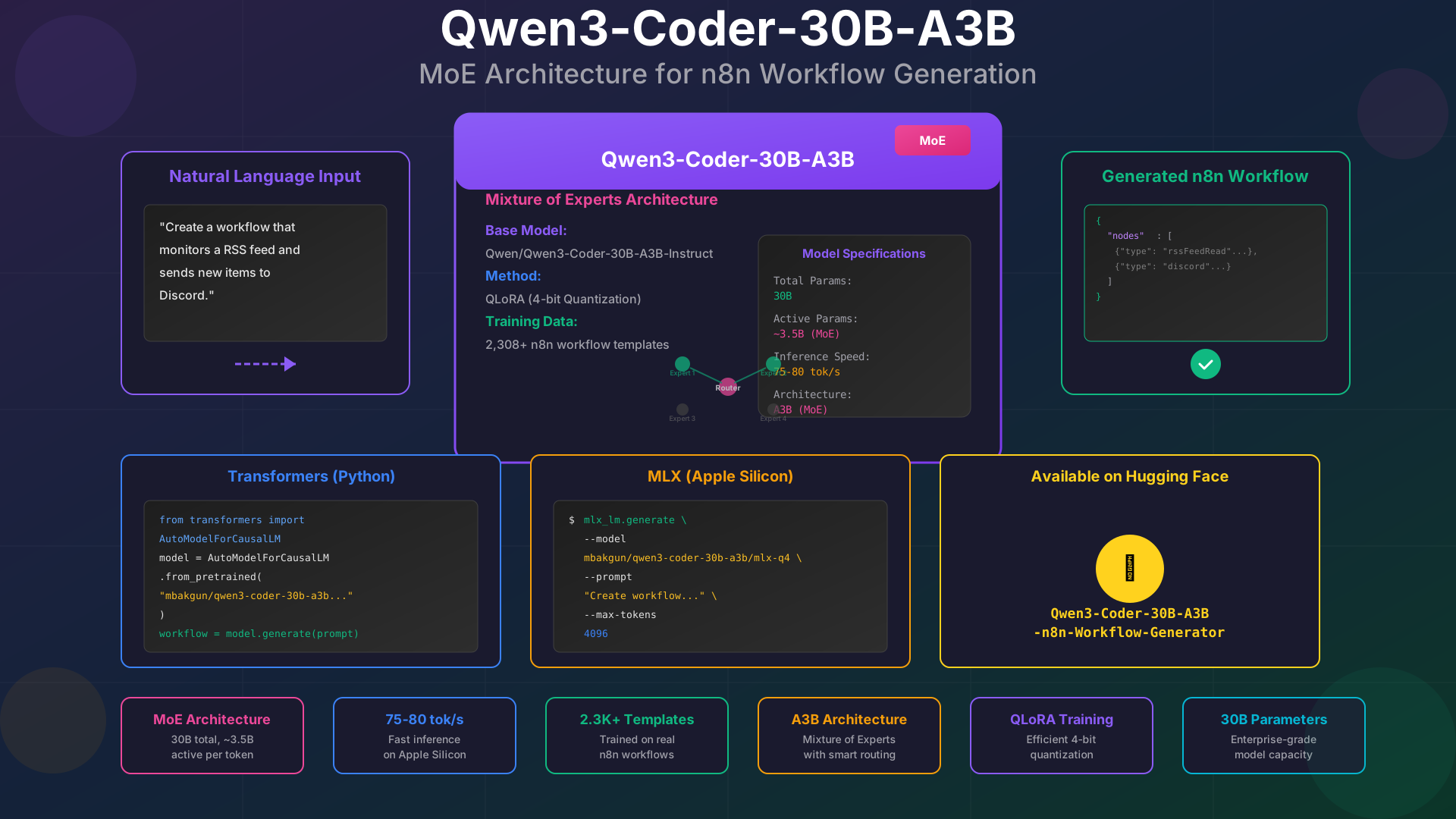
We're excited to announce the release of Qwen3-Coder-30B-A3B-n8n-Workflow-Generator, our second-generation specialized model for generating n8n workflow configurations. This release represents a significant architectural upgrade from our first model, moving from a dense 14B parameter architecture to a 30B parameter Mixture of Experts (MoE) model that delivers superior quality with faster inference speeds.
The Evolution: From Dense to MoE
Our journey in building specialized n8n workflow generation models began with Qwen2.5-Coder-14B, a dense architecture model where all 14 billion parameters were active for every token during inference. While this model performed well, we recognized an opportunity to leverage MoE (Mixture of Experts) architecture to achieve better quality with improved efficiency.
The new Qwen3-Coder-30B-A3B model represents a fundamental shift in architecture:
- Model 1 (Dense): Qwen2.5-Coder-14B - 14B parameters, all active per token
- Model 2 (MoE): Qwen3-Coder-30B-A3B - 30B total parameters, ~3.5B active per token
This architectural change enables us to maintain the quality of a 30B parameter model while achieving inference speeds closer to a 3.5B parameter model—a game-changing improvement for practical workflow generation.

Why MoE Architecture Matters
Mixture of Experts (MoE) is a neural network architecture that uses multiple "expert" networks, each specialized for different types of inputs. Instead of using all parameters for every token, a router intelligently selects which experts to activate based on the input.
In the A3B (Activate 3 Billion) architecture used by this model:
- Total Parameters: 30 billion parameters across all experts
- Active Parameters: Only ~3.5 billion parameters activated per token
- Expert Routing: Intelligent router selects 1-2 most relevant experts for each token
- Efficiency Gain: Significantly faster inference while maintaining 30B model quality
This means you get the quality and capability of a 30B parameter model with the speed and resource efficiency of a much smaller model. For n8n workflow generation, this translates to faster response times and better workflow quality.
Real-World Performance Metrics
We've tested the model extensively on Mac Pro M4 with 64GB RAM and 273GBps memory bandwidth. The results demonstrate the power of MoE architecture combined with MLX optimization:
- Inference Speed: 75-80 tokens per second with MLX Q4 quantization
- Workflow Generation Time: Complete workflow generation in approximately 15 seconds
- Complex Workflow Handling: Successfully generates multi-node workflows with AI agents, HTTP requests, and structured data extraction
- Memory Efficiency: Q4 quantization enables efficient operation on consumer hardware
These performance metrics make the model practical for real-time workflow generation, whether integrated into applications or used directly by developers and automation engineers.
Technical Deep Dive
Understanding the technical foundation helps explain why this model represents such a significant improvement over dense architectures.
Base Model: Qwen3-Coder-30B-A3B-Instruct
The model is built on Qwen/Qwen3-Coder-30B-A3B-Instruct, a state-of-the-art code generation model featuring the A3B MoE architecture. This base model provides excellent code understanding and generation capabilities, which we've specialized for n8n workflows through fine-tuning.
Fine-Tuning Method: QLoRA
We used QLoRA (Quantized Low-Rank Adaptation) to efficiently fine-tune the model on n8n-specific workflows:
- 4-bit Quantization: Reduces memory requirements while maintaining performance
- LoRA Rank: 8 for efficient adaptation
- LoRA Alpha: 16 to control adapter influence
- LoRA Dropout: 0.05 for regularization
- Training Steps: 451 steps across 3 epochs
- Sequence Length: 8192 tokens for complex workflows
- Learning Rate: 1e-4 for stable training
Training Dataset
The model was fine-tuned on the n8nbuilder-n8n-workflows-dataset, containing over 2,308 high-quality n8n workflow templates. Each template was converted into an instruction-following format, enabling the model to learn the mapping between natural language descriptions and complete n8n workflow JSON configurations.
The dataset covers diverse automation scenarios including:
- RSS feed monitoring and notifications
- API integrations and data synchronization
- Email processing and automation
- Social media cross-posting
- Database operations and data transformation
- AI agent workflows with multiple nodes
How to Use the Model
The model is available on Hugging Face in multiple formats to suit different use cases and infrastructure requirements.
Using Transformers (Python)
For most users, the Transformers library provides the easiest way to use the model:
from transformers import AutoModelForCausalLM, AutoTokenizer
import torch

model_name = "mbakgun/qwen3-coder-30b-a3b-n8n-workflow-generator"
tokenizer = AutoTokenizer.from_pretrained(model_name, trust_remote_code=True)
model = AutoModelForCausalLM.from_pretrained(
    model_name,
    torch_dtype=torch.bfloat16,
    device_map="auto",
    trust_remote_code=True
)

system_prompt = "You are an expert n8n workflow generation assistant. Your goal is to create valid, efficient, and functional n8n workflow configurations."

user_input = "Create a workflow that monitors a RSS feed and sends new items to Discord."

prompt = f"{system_prompt}\n\n{user_input}"

inputs = tokenizer(prompt, return_tensors="pt").to(model.device)
outputs = model.generate(
    **inputs,
    max_new_tokens=4096,
    temperature=0.7,
    do_sample=True
)

workflow_json = tokenizer.decode(outputs[0], skip_special_tokens=True)
print(workflow_json)
Using MLX (Apple Silicon)
For Mac users with Apple Silicon, MLX provides optimized inference that runs efficiently on Apple hardware. The Q4 quantized version is particularly well-suited for local deployment:
mlx_lm.generate \
  --model mbakgun/qwen3-coder-30b-a3b-n8n-workflow-generator/mlx-q4 \
  --prompt "You are an expert n8n workflow generation assistant. Your goal is to create valid, efficient, and functional n8n workflow configurations.\n\nCreate a workflow that sends Slack notifications when GitHub issues are created." \
  --max-tokens 4096 \
  --temp 0.7
MLX offers excellent performance on Apple Silicon, with the Q4 quantized model achieving 75-80 tokens per second on Mac Pro M4 with 64GB RAM. This makes local inference practical for many use cases.
Using LoRA Adapter
If you want to load the base model and apply the LoRA adapter separately for flexibility:
from transformers import AutoModelForCausalLM, AutoTokenizer
from peft import PeftModel
import torch

base_model_name = "Qwen/Qwen3-Coder-30B-A3B-Instruct"
adapter_name = "mbakgun/qwen3-coder-30b-a3b-n8n-workflow-generator"

tokenizer = AutoTokenizer.from_pretrained(base_model_name, trust_remote_code=True)
base_model = AutoModelForCausalLM.from_pretrained(
    base_model_name,
    torch_dtype=torch.bfloat16,
    device_map="auto",
    trust_remote_code=True
)

model = PeftModel.from_pretrained(base_model, adapter_name)
model = model.merge_and_unload()  # Optional: merge adapter into base model
Performance Comparison: Dense vs MoE
The architectural upgrade from dense to MoE brings several key advantages:
Quality Improvements
With 30B total parameters (compared to 14B in the previous model), the MoE architecture provides significantly more capacity for learning n8n workflow patterns, node configurations, and best practices. This translates to:
- More accurate workflow generation
- Better handling of complex multi-node workflows
- Improved understanding of n8n-specific requirements
- More reliable node configuration and parameter mapping
Speed Improvements
Despite having more total parameters, the MoE architecture activates only ~3.5B parameters per token, resulting in:
- Faster inference compared to dense 30B models
- Inference speeds comparable to much smaller models
- Better resource utilization
- Practical real-time workflow generation
Efficiency Gains
The MoE architecture enables efficient operation on consumer hardware:
- Lower memory requirements during inference
- Faster response times for end users
- Reduced computational costs
- Better scalability for production deployments
Real-World Use Cases
The improved architecture enables the model to handle more complex automation scenarios effectively:
Complex Multi-Node Workflows
The model excels at generating workflows with multiple interconnected nodes, including AI agents, HTTP requests, data transformations, and conditional logic. The 30B parameter capacity enables better understanding of complex workflow structures.
Structured Data Extraction
Workflows that require extracting and transforming structured data from various sources benefit from the model's improved understanding of data manipulation patterns and n8n's data handling capabilities.
API Integration Workflows
The model generates accurate API integration workflows with proper authentication handling, request formatting, and response parsing. The MoE architecture's specialized experts handle different aspects of API integration effectively.
AI Agent Workflows
Complex workflows involving AI agents, multiple decision points, and iterative processing are handled more effectively with the increased model capacity and specialized expert routing.
Available Model Formats
The model is available in multiple formats to suit different deployment scenarios:
- Full Merged Model: Complete fine-tuned model with adapter merged into base (PyTorch format)
- LoRA Adapter: Separate adapter weights for flexible loading and merging
- MLX Q4 Quantized: Optimized for Apple Silicon with 4-bit quantization for efficient local inference
Each format serves different use cases, from research and experimentation to production deployment on various hardware platforms.
Limitations and Considerations
While the MoE architecture provides significant advantages, it's important to understand its limitations:
- Manual Validation Required: Generated workflows should be reviewed and tested before production deployment
- Token Length Limits: Very long workflows (over 8,192 tokens) may be truncated or need to be generated in parts
- Training Data Scope: Model trained on public templates, so highly specialized workflows may need manual adjustment
- MoE Routing: Expert routing may occasionally select suboptimal experts, though this is rare
- API Credentials: Generated workflows include placeholder credentials that must be configured with actual API keys
These limitations are typical for AI-generated code and don't diminish the model's value as a powerful starting point for workflow development.
Future Developments
This MoE model represents a significant step forward, but we're already exploring further improvements:
- Larger MoE models with more experts for even better quality
- Specialized models for specific industries or use cases
- Improved handling of edge cases and complex workflows
- Better integration with n8n's native features
- Real-time workflow optimization and suggestions
As the n8n ecosystem continues to grow and more workflow templates become available, we can continue improving model performance and expanding its capabilities.
Get Started Today
The Qwen3-Coder-30B-A3B-n8n-Workflow-Generator model is available now on Hugging Face. Whether you're a developer looking to integrate AI workflow generation, a researcher exploring MoE architectures, or an n8n user wanting to experiment with AI-powered automation, this model provides a solid foundation.
For the easiest experience, try n8n Builder, which provides a user-friendly interface powered by this and other models. Simply describe your automation needs, and get a complete n8n workflow in seconds with the quality and speed benefits of MoE architecture.
The journey from dense to MoE architecture demonstrates how architectural innovations can deliver both better quality and improved efficiency. We're excited to see what workflows you'll build with this new model.